Modular Auto-Rigging Framework
Maya / Python • Senior Character Technical Artist • 31st Union (2K) • 2019–Present
Inherited from Technical Director Eric Pavey and expanded to cover the studio's full non-humanoid cast, this system builds complete, animator-ready character rigs from a per-character build script — referenced skeleton in, finished rig out — across an entire cast of heroes, costume variants, and creatures.
Demo Reel
The Problem
A hero-based multiplayer game needs a large, growing cast: bipedal heroes with costume variants, quadrupeds, and non-humanoid creatures. Hand-rigging each one doesn't scale — and skeletons keep changing during production, so every joint edit would traditionally mean redoing rig work by hand.
The animation team also needed consistent controls and workflows across every character, so muscle memory transfers between rigs.
The Solution
A Python framework where every rig is defined as a small script that composes reusable limb modules — FK chains, IK/FK limbs, spines, correctives, eye look-ats — and overrides only what's unique to that character.
The build runs as an ordered pipeline of ~30 named steps. A new costume variant often needs only a handful of lines; a winged creature replaces just the limb steps that differ from the base biped.
Pipeline
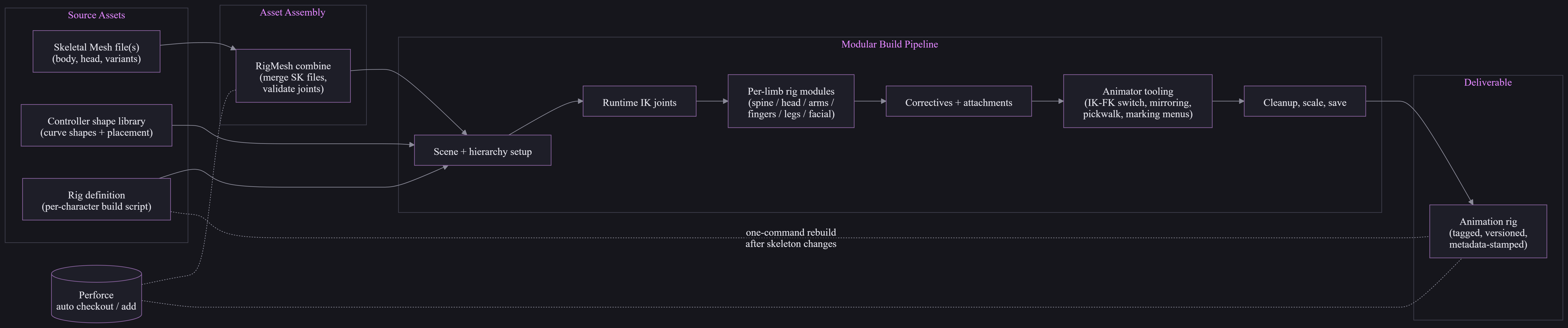
Source assets → asset assembly → modular build pipeline → finished rig, with version-control automation and a one-command rebuild loop.
Key Design Points
Per-Limb Granularity
Body regions (spine, head, arms, fingers, legs, facial) are separate build steps. Character scripts subclass the framework and override individual steps — one framework covers bipeds, quadrupeds, and creatures with extra or missing limbs.
Non-Destructive Iteration
Rigs are built on top of a referenced skeleton, never baked into it. Every rig is stamped with the build script that created it, so any rig can be rebuilt with one command after a skeleton change.
Multi-File Asset Assembly
Character meshes are split across files (shared heads reused between hero variants). An assembly stage merges them and validates the joint set before rigging, with joint identity tracked by naming convention so cross-file assembly stays robust.
Robust Node Layer
A lightweight wrapper tracks Maya nodes by UUID so tools never lose references when names or hierarchy change. Every rig element carries typed metadata attributes that downstream tools query instead of relying on names.
Animator Tooling Included
- IK/FK switching with pose matching + smart bake over a range
- Space switching with optional auto-keying
- Pose and animation mirroring
- Pickwalk navigation and custom marking menus
- One-click reset to build-time default pose
Pipeline Integration
Version-control checkout/add is automated inside the build. The framework also auto-configures HumanIK for mocap, generates mocap scene files, and manages the attachment-joint conventions used by the game engine for weapons and props.
Rigs Built With the Framework
A sample of the hero cast in production animation — every rig built through the framework.
Now playing: Arbor
Results
- 15+ characters — heroes, costume variants, and creatures — rigged through the framework.
- Full rig build in ~2 minutes; skeleton-change turnaround went from days of manual work to a single rebuild command.
- New costume-variant rigs authored in hours.
- One consistent control scheme across the entire cast — animators move between rigs without relearning anything.
All footage and imagery shared with studio approval. No proprietary code is shown.